
So you are feeling AI FOMO? Good! It means you care about staying relevant. But it leaves one question: where should you start? Let me be the bearer of good news: To set a foundation for success, you don’t need all the answers, just the right questions!
Direct the first question at yourself.
1. Why do we want to include AI in our MSC?
- “To modernize our tools”
- “To increase efficiency across the board.”
- “Because leadership wants to invest in AI this year.”
- “Because we want to stay technologically competitive.”
These examples are vague, tech-first or pressure-driven. If your own answer is similar to any of these, you risk spending resources building something that in the end will not be adopted by users. If you want to optimize the value per dollar spent, focus on solving real-life challenges that your operational teams are facing, such as;
- "Because we’ve identified bottlenecks in a workflow where AI could assist without disrupting the human flow."
- "Because we’re facing increased volumes of QC tasks that our teams can’t keep up with."
- “To reduce repetitive manual tasks that our operators hate doing.”
To help you turn your answer into something more like these, head on to question #2!
2. What problems are we trying to solve?
To answer this question at Codemill, a UX researcher would shadow operators, interview stakeholders across teams or map out key workflows end-to-end. The intention is to identify which tasks or workflows can benefit from AI enhancement. If you are looking to DIY the research, these are the top three tips from my colleagues:
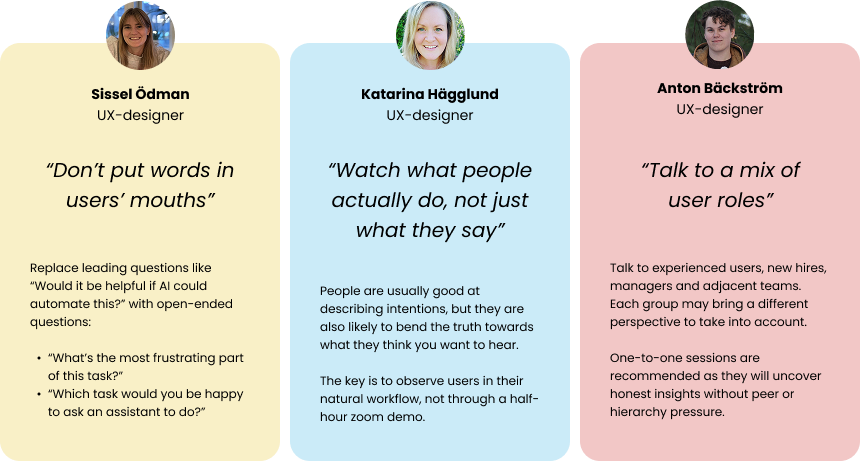
Finding the right problem ensures you don’t end up building the wrong thing. This is where bringing in an outside UX researcher can be invaluable. External facilitators come in without bias toward existing workflows or technologies. In addition, users are often more candid when speaking to someone who isn’t part of their management chain. That neutrality leads to deeper insights and problem definitions that are both honest and actionable.
3. How might we solve this problem?
Once you have identified a real operational challenge, the next step is to open up the opportunity space. We want to be careful jumping straight from problem to solution, as it often means you land on obvious fixes and miss the most innovative ones.
A Codemill UX:er would typically bring together a task force of operational leads, end users, developers, and product owners to reframe research findings into opportunity-framing questions. This is what the How Might We (HMW) workshop is designed to do.
Consider the following problem statement:
"We’re facing increased volumes of QC tasks that our teams can’t keep up with."
On its own, the negative framing of the problem is daunting and uninspiring. In the HMW workshop, we work together to turn it into creativity-sparking questions which can act as springboards for ideation:
- “How might we reduce manual bottlenecks in content prep and QC so that scaling doesn’t depend solely on human effort?”
- “How might we ensure localized content maintains quality and cultural accuracy even as we scale rapidly?”
- “How might we empower operations with smarter tools so they can focus on high-value QC while repetitive tasks are automated?”
This workshop format may sound simple, but it prevents teams from rushing to the first solution and building something less than ideal. When done well, the workshop creates clarity, alignment, and a prioritized set of opportunity statements to fuel ideation.